
Our River, Our Environment.
Our club has been in existence since 1874 but of course the river has been there much longer and it is embedded in the club’s ethos that we must look after it.
Maintaining Our River
Our stretch of the river cuts down one of the great divides of Derbyshire between the limestone plateau to the west and the great gritstone ridge and moor to the east, each bringing a unique mix of minerals and nutrients and attracting creatures of all shapes and sizes.
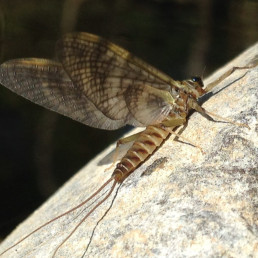
Fly fishing involves getting close up to the river and even in it, where every rustle of the trees, dart of a dipper, flash of a kingfisher or hover of a Mayfly brings an added dimension to the calming effects of a few hours with rod in hand.
But it does not remain an idyllic environment on its own. The Club works closely with a number of other stakeholders including the Environment Agency, The Angling Trust, Local Authorities, Derbyshire Police Rural Crime team and the Derbyshire Archaeological society to understand and monitor the river levels and health. We also maintain good relationships with local landowners and help each other out with any poaching or pollution problems.
Wildlife on the River
Regular Work Parties
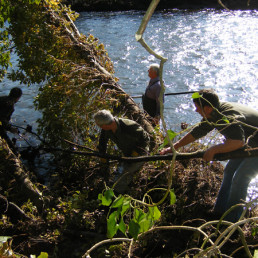
Several times a year club members join in working parties to collect litter, repair banks, clear paths, prune trees and remove obstructions supplemented by ad hoc work as required. Unfortunately we do suffer from the careless activities of others upstream from us in Matlock Bath, and especially in Cromford Meadows so litter picking in particular is a never ending task!
River Health Data
We monitor the river health using two nationally recognised testing regimes both carried out on a regular basis to build up databases of changes in health over time:
Anglers Riverfly Monitoring Initiative (ARMI) involves taking kick samples from the riverbed on a monthly basis from 2 registered sites on our 3 mile stretch of river. We then sift through the samples and count the various types of aquatic nymphs and invertebrates, the presence of which is a really good guide to the health of the river. The score is then compared to previous results and reported back to the ARMI head office who have hundreds of clubs involved in this scheme and who interact with the Environment Agency. The 2022 results show a consistently very healthy river in spite of the local reconstruction of Lea Road.
Water Quality Monitoring Network Member
The Water Quality Monitoring Network is a recent nationwide network created by the Angling Trust to help everyone understand the risk pollution issues in our rivers The aim is for the club and Angling Trust to understand the quality of our water and to establish a solid foundation of data which can be used to better understand the factors affecting water quality.
CFFC was the first organisation on the Derwent to join and since November 2022 we have started to test the water for: Phosphates, Nitrates, Electrical conductivity, Temperature, Water levels, Flow rates, Presence of algal blooms, Presence of pollution.
- Phosphates
- Nitrates
- Electrical conductivity
- Temperature
- Water levels
- Flow rates
- Presence of algal blooms
- Presence of pollution
By sharing results for all our testing with national organisations and local landowners we can hold miscreants to account, take urgent action when necessary and ensure the water is a clean as it can be.
With an abundance of nature such as kingfishers, dippers and even otters we feel as the guardians of the river that this work is crucial for the preservation of our local environment.
Wild Trout Trust visit to River Derwent, Cromford.
The Wild Trout Trust (WTT) are a conservation charity working across the UK and Ireland to help anyone interested in making a better world for our rivers, lakes and their wildlife, including wild trout. Flourishing wild trout populations are a sign of the health of our waterways and the land around them. Cromford Flyfishers Club, and many of their members, are also members of the WTT and share their desire for a better environment. In April of this year the WTT representative made an advisory visit to the Cromford section of the River Derwent. If you want to read their report then please click on the image above to download it